Can Portable Dryers Dry a Full Load?
Portable dryers can dry a full load, provided the load matches the machine's drum size. Here is how to figure out the right capacity for your household before you buy.
Yes, portable dryers can dry a full load. The operative word is full relative to the machine, not to a standard household dryer. Portable dryers range from 1.5 to 3.5 cubic feet in drum size, which accommodates five to thirteen pounds of laundry per cycle. That covers a small to medium load for one or two people.
The confusion usually comes from comparing portable dryer capacity to a standard dryer's 7 to 9 cubic feet. By that comparison, every portable dryer is undersized. But if you think in terms of how much laundry one or two people actually generate between wash sessions, a 2.6 to 3.5 cubic foot portable dryer handles that volume without difficulty. The key is loading the drum to no more than two-thirds full so air can circulate freely.
Products mentioned in this post


What Counts as a Full Load?
The definition of a full load depends on the machine, not on a universal standard. A standard household dryer treats 12 to 15 pounds of laundry as a full load. A compact or portable washer's full load is typically 8 to 10 pounds. Portable dryers, however, generally have smaller drums than their paired washers, which means the effective dry capacity per cycle is less than the wash capacity.
A 1.5 cubic foot portable dryer handles five to seven pounds effectively. A 3.5 cubic foot model manages ten to thirteen pounds. The rule that matters practically is filling the drum no more than two-thirds of its volume: beyond that point, clothes pile on top of each other, tumbling stops being effective, and the surface area exposed to circulating air drops sharply. Stuffing the drum adds cycle time and often leaves the center of the load damp even when the exterior feels dry.
Capacity Comparison of Top Portable Dryers
Looking at the models with the strongest review data, the EUHOMY 3.5 Cubic Feet portable dryer (ASIN: B08N4DVVYS) has the highest capacity in this group, rated for approximately thirteen pounds per load. At $314.99 with 4.2 stars from 3,600 reviews, it is the best-documented large-capacity option. For comparison, the Panda Pan725sf (ASIN: B00EAY540S) holds 1.5 cubic feet, handling five to seven pounds, at $197.99 and 4.4 stars from 3,200 reviews.
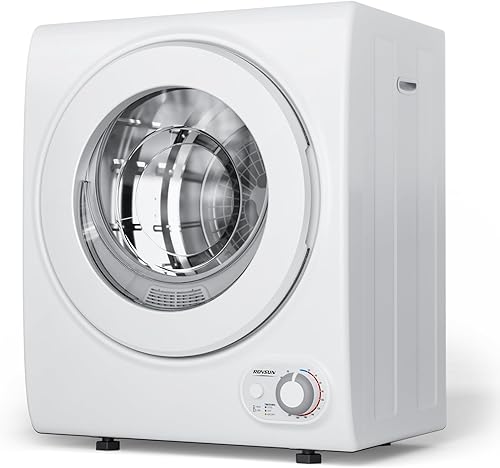
The COSTWAY 1700W Electric Portable Clothes Dryer sits between those at 3.22 cubic feet and 13.2 pounds rated capacity, with higher wattage that speeds up drying relative to lower-powered models. The COSTWAY GYJ25-78 (ASIN: B07F618LKC) at $189.99 and 4.2 stars from 3,600 reviews does not list a precise cubic footage but is widely bought for average portable loads. The ROVSUN Classic Knob Control (ASIN: B08X6ZJR6C) specifies a 5.5 pound capacity, appropriate for singles doing small to medium loads.
How Fast Can a Portable Dryer Dry a Full Load?
Drying time is a function of load size, fabric type, dryer wattage, and how much water the washer's spin cycle extracted beforehand. Most portable dryers on 120V take 60 to 120 minutes for a full load. The COSTWAY 1700W model's higher wattage can reduce that to approximately 40 to 60 minutes for a medium load of everyday cotton items. The Panda Pan725sf at lower wattage may need 90 to 120 minutes for a similar weight.
Heavier fabrics extend cycle time the most. A load of towels or denim will take longer than a load of lightweight shirts and underwear even at the same weight. Running a high-speed spin cycle in your washer before transferring clothes to the dryer makes the single biggest time difference available to you. Starting the dryer with clothes that are damp rather than dripping reduces total drying time by 20 to 40 minutes in many cases.
Space and Ventilation Requirements
Most portable dryers in this category are vented: they exhaust moist air through a hose that needs to reach a window or exterior vent. The Panda Pan725sf and EUHOMY 3.5 cu ft models are both vented designs that require window access. The COSTWAY GYJ25-78 is also vented. Without proper venting, humid air recirculates inside the drum and drying becomes inefficient.
Some portable dryers use condensation rather than venting, collecting moisture in a reservoir. The COSTWAY 23597-CYEP is a large-format top-loader style in this category, though its 3.8 star rating suggests a less consistent owner experience. Ventless models offer placement flexibility since they do not need a window, but they cost more, dry more slowly, and require regular reservoir emptying. Measure your space and confirm your window access before deciding between vented and ventless.
Choosing the Right Portable Dryer for Your Household
For a single person or couple doing small frequent loads, the Panda Pan725sf (1.5 cu ft, $197.99, 4.4 stars) or ROVSUN Classic Knob Control (5.5 lb, $159.99, 4.4 stars) are well-documented choices at manageable prices. For a couple or small family wanting fewer cycles per week, the COSTWAY GYJ25-78 ($189.99, 4.2 stars from 3,600 reviews) delivers more capacity at a lower price than the EUHOMY.
For the largest loads a portable dryer can handle, the EUHOMY 3.5 cu ft ($314.99, 4.2 stars from 3,600 reviews) is the top option. Match the dryer capacity to your typical wash load; buying a dryer smaller than your washer's output means splitting loads, which negates some of the convenience. As a general rule, choose a dryer rated for at least as many pounds as your washer can wash.
Tips to Maximize Drying Efficiency
Loading technique affects drying results as much as machine choice does. Fill the drum loosely, to no more than two-thirds capacity, so clothes can tumble freely. Separate heavy and light items when possible: tumbling a mix of jeans and cotton shirts means the jeans come out damp while the shirts are overdone, or you run the cycle long enough for the jeans and slightly over-dry the shirts.
Dryer balls, which are rubber or wool balls placed in the drum, keep clothes separated during tumbling and improve air circulation. They also reduce static on synthetic fabrics. Use a medium heat setting for cotton and mixed loads; high heat can shrink natural fibers. Clean the lint filter after every cycle without exception: a partially blocked filter reduces airflow enough to add 20 or more minutes to a typical cycle. If your dryer has a cool-down period at the end of the cycle, run it, since it helps prevent wrinkles from setting in during the first few minutes after the heat stops.
Portable Dryer vs. Standard Dryer: Load Capacity
A standard full-size dryer handles 15 to 20 pounds per cycle in a 7 to 9 cubic foot drum. The best portable dryers top out at 3.5 cubic feet and 13 pounds. For a household doing two or three large mixed loads per week, a standard dryer finishes in fewer cycles. For a single person or couple doing laundry in smaller, more frequent batches, the difference in throughput matters less than the savings in installation cost and space.
A family of four using a standard-size washer will find that a portable dryer requires two or three cycles for each wash load. That friction becomes a practical problem quickly. For individuals and couples who already wash in small batches matched to a portable washer's capacity, a portable dryer of appropriate size completes the full laundry cycle without requiring a separate trip or an additional appliance.
Frequently asked questions
How many pounds of clothes can a portable dryer hold?
Capacity varies by model. Smaller portable dryers like the Panda Pan725sf handle five to seven pounds. Larger models like the EUHOMY 3.5 cu ft manage up to thirteen pounds. Always check the manufacturer's rated load capacity and do not exceed it, as overfilling prevents effective tumbling.
Can a portable dryer dry a king size sheet?
A king sheet weighs roughly two to three pounds dry, so the weight is not the issue. The problem is bulk: a large sheet bunches in a small drum and does not expose enough surface area to airflow. Most portable dryers can dry a single flat sheet, but a complete king set with fitted sheet and pillowcases is better split across two cycles unless you have the 3.5 cu ft EUHOMY or a similar large-capacity model.
Do portable dryers use a lot of electricity?
Portable dryers are generally efficient on a per-load basis because they process smaller loads. A typical 120V portable dryer uses 1.5 to 2.5 kWh per cycle, which works out to roughly $0.20 to $0.50 per load at average US electricity rates. A standard 240V dryer uses 3 to 5 kWh per load but dries twice as much per cycle.
Can I vent a portable dryer into a bucket of water?
No. That approach traps humid air and creates a mold and mildew risk inside the machine. Vented portable dryers must exhaust moist air outdoors through a window vent kit. If outdoor venting is not possible, choose a ventless condensation dryer, which is designed to handle moisture internally without an exhaust path.