Hand Washing vs Machine Washing Clothes: What Should You Choose?
Not sure whether to hand wash or machine wash your clothes? We break down the pros, cons, and hidden costs of each method so you can pick the right approach for your space and lifestyle.
For most households, machine washing wins on time and effort for any load larger than a few items. Hand washing has a genuine place for fragile fabrics that cannot handle mechanical agitation, but it is not a practical substitute for regular laundry at scale. The middle ground, one that often gets overlooked, is a compact portable washer that handles everyday loads without permanent installation.
The honest comparison between hand washing and machine washing comes down to three things: what you are washing, how much of it, and how much of your time it is worth. Delicate silk or lace that carries a hand-wash label belongs in the sink. A week's worth of shirts and socks does not.
Products mentioned in this post


When Hand Washing Makes Sense
Hand washing gives you direct control over agitation and water temperature, which matters for fabrics that cannot tolerate a machine's mechanical action. Silk, fine lace, loosely knitted wool, and beaded garments all carry a higher risk of damage in even a gentle machine cycle. For a small number of these items each week, hand washing is genuinely faster than setting up a machine run. The downsides become apparent at scale: manual wringing leaves more moisture in the fabric than a spin cycle, extending drying time, and the physical effort adds up over larger loads. If your typical wash day involves mostly delicates in small batches, hand washing covers the need without any equipment investment.
The Case for a Portable Washing Machine
A portable washer like the Giantex EP21684 (4.2 stars from more than 15,200 reviews) handles up to 20 pounds per load, which is far more than a productive hand-wash session, and the spin cycle extracts significantly more water than manual wringing. For a small apartment or RV, where permanent washer hookups do not exist, a portable machine attaches to a standard faucet and drains into a sink or utility drain. The time savings compared to hand washing are considerable for any household running two or more loads a week. The upfront cost of a quality portable washer, around $150 for a semi-automatic model, pays for itself quickly in time and reduced laundromat trips.
Comparing Water and Energy Use
A typical hand-wash session for a small batch of clothes uses 5 to 10 gallons of water, depending on how many rinses you do. A portable washer cycle uses 10 to 20 gallons but handles a much larger load in a single pass. When you add up multiple hand-wash sessions to cover the same volume of laundry, the water totals become comparable or higher. Machine spin cycles also extract more moisture from fabric, which means the dryer or drying rack works less to finish the job. The Hamilton Beach HBPW3O2AMZ (4.3 stars, 1,500 reviews) offers a 3.0 cu ft drum that processes a full small-household load efficiently without large water consumption.
Effect on Fabric Longevity
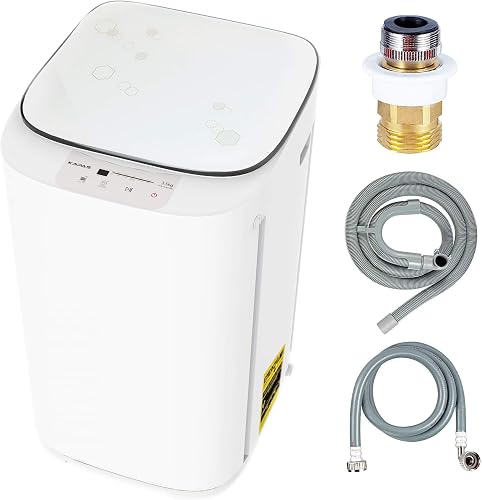
Hand washing produces the least mechanical stress on fabrics because you control the agitation directly. Machine washing, even on a delicate cycle, involves some tumbling or pulsation that adds wear over time. That said, the difference for most everyday fabrics, cotton shirts, synthetic workout gear, household linens, is negligible over the machine's service life. Where the gap matters is with knits, embellished garments, and items with weak seams. Modern portable washers address this with purpose-built delicate cycles: the Kapas KPS35-735H2 (4.1 stars) offers 8 programs including a dedicated gentle wash that mimics slow, low-agitation hand movement. For anything not labeled hand-wash only, the machine cycle is safe and effective.
Space and Lifestyle Considerations
Hand washing requires only a sink and some counter space, making it zero-footprint in terms of equipment. A portable washer needs 2 to 3 square feet of floor or counter space and a nearby water source. The Costway GT-23104-CYWH (5.5 lb capacity, 3.7 stars) is a countertop unit compact enough to store in a cabinet between uses. For singles or couples with modest weekly laundry volume, this footprint is easy to accommodate. For households that push even a moderate volume, the larger floor-standing models like the Giantex EP21684 or the Costway FP11048US (20 lb, 4.2 stars) justify the space they occupy with the time they save every week.
Cost Comparison: Hand vs Machine
Hand washing costs only water, detergent, and your time. A portable washer adds a purchase cost in the $85 to $450 range and a modest ongoing electricity draw. The time factor is where the comparison shifts significantly. Washing three loads per week by hand takes roughly 1.5 to 2 hours of active work, week after week. A portable washer runs mostly unattended: load it, start the cycle, and come back in 20 to 40 minutes. The machine pays for itself in reclaimed time within a few months of regular use. For households where laundry is frequent, the machine cost is not an expense but an investment in time.
The Bottom Line: Which Should You Choose?
Hand wash items specifically labeled for it, items with embellishments, and anything in a delicate fabric you are not willing to risk. Machine wash everything else. For households without a permanent washer connection, a portable machine is the practical bridge. The Giantex EP21684 (20 lb, $149.99) is a reliable, high-volume choice for its price range. The Costway FP11048US (20 lb, 4.2 stars) is a comparable alternative with a similar footprint. Match the machine to your typical load size and wash frequency, and you will have a setup that handles the bulk of laundry efficiently while leaving hand washing for the handful of items that genuinely need it.
Frequently asked questions
Is hand washing better for clothes than machine washing?
Hand washing is gentler on delicate fabrics like silk or lace, but for everyday clothes, machine washing with a gentle cycle is just as effective and much faster. The key is matching the method to the fabric type and load size.
Does hand washing use less water than a washing machine?
Hand washing can use less water per garment (5-10 gallons per small load), but if you wash many items separately, total water use can exceed a machine's. Portable washers typically use 10-20 gallons per cycle, which is efficient for full loads.
Can a portable washer wash delicate items safely?
Yes, many portable washers have a delicate cycle with gentle agitation and adjustable spin speeds. Models like the Kapas KPS35-735H2 offer 8 cycles including delicate, making them safe for most items that aren't labeled hand-wash only.
How much time does a portable washer save compared to hand washing?
A portable washer can wash a full load in 30-45 minutes, while hand washing the same amount may take 1-2 hours plus drying. For weekly laundry, a portable washer saves several hours per month.