How Loud Are Portable Washing Machines?
Portable washing machines range from 45 dB to 72 dB. Learn what affects noise levels and find a quiet model that fits your space and household size.
Portable washing machines generate between 45 and 72 decibels during a typical wash and spin cycle. At 45 dB, a machine is about as loud as a quiet library. At 72 dB, it is in the same range as a vacuum cleaner running in the next room. Most portable washers fall somewhere between those two points depending on the model, its drum construction, and the cycle it is running.
For apartment dwellers or anyone sharing walls with neighbors, this range matters. A 10-decibel difference feels roughly twice as loud to the human ear, so the gap between a 50 dB compact unit and a 72 dB fully automatic machine is substantial in practice. The good news is that quieter portable washers are available across several price points, and the spec sheet usually tells you what to expect.
Products mentioned in this post


What Affects Portable Washer Noise Levels?
Several design and usage factors determine how much noise a portable washer produces. Drum material is one of them: plastic drums dampen vibration more effectively than stainless steel, which is why many of the quieter compact units use polypropylene construction. The type of operation also plays a role. Manual and semi-automatic washers with fewer motorized components run more quietly than fully automatic machines that cycle pumps, valves, and higher-speed motors throughout the wash. Spin speed is directly linked to noise during the spin phase; a machine running at 1350 RPM generates considerably more vibration than one spinning at 800 RPM. Surface contact matters too. A countertop unit resting on a solid, stable surface produces less resonance than a floor-standing model sitting on a flexible wooden floor.
Typical Decibel Ranges for Portable Washers
Portable washers group naturally into three noise tiers based on published specs. At the quiet end, 45 to 50 dB, you find compact countertop units like the Costway GT-23104-CYWH, which is rated at 45 dB. These are the machines that can realistically run in the same room while you work or sleep without significant disruption. In the middle range, 50 to 60 dB, sit semi-automatic models like the Costway FP11048US at 50 dB. These produce a steady hum that is audible but not intrusive in an adjacent room. At the louder end, 65 to 72 dB, you find fully automatic machines with stainless steel drums and high-speed spins, including the Hamilton Beach HBPW3O2AMZ rated at 72 dB. That is comparable to a vacuum cleaner and will be clearly audible through interior walls.
Quiet Models Worth Considering for Small Spaces
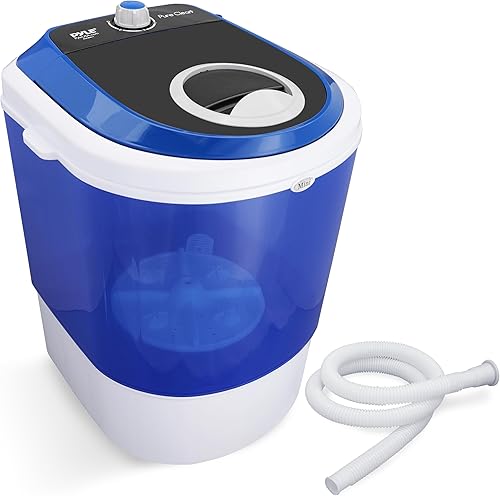
For noise-sensitive environments, start with machines that publish a decibel rating and fall below 55 dB. The Costway GT-23104-CYWH at 45 dB and 5.5 lb capacity is among the quietest available. Its manual top-load design and polypropylene drum keep noise to a minimum throughout the cycle. The Pyle FBA-PUCWM11_0, rated at 57 dB, is another low-noise option with simple knob controls and a plastic drum. Stepping up in capacity without much noise penalty, the Costway FP11048US handles 20 lb at 50 dB and uses a semi-automatic design that keeps motor noise moderate. These three cover the main size brackets for buyers where quiet operation is the primary filter.
Louder Models and When They Make Sense
Noise is not the only consideration, and the louder machines in the category exist because their performance justifies the trade-off for some buyers. The Hamilton Beach HBPW3O2AMZ at 72 dB and 3.0 cu ft is a fully automatic machine with 12 wash cycles, a stainless steel drum, and the kind of hands-off convenience that a compact semi-automatic cannot match. For households in detached houses or with noise-tolerant neighbors, that 72 dB rating is not a barrier. Similarly, the Giantex EP21684 runs noisier during its 1350 RPM spin cycle but has accumulated over 15,200 reviews at 4.2 stars, which reflects a large group of buyers who consider the performance worth the noise.
How to Reduce Portable Washer Noise at Home
Even a moderately loud machine can be made less disruptive with a few practical steps. The most effective is placing the unit on a thick rubber anti-vibration mat or purpose-built washer pad. These absorb the vibration that travels through the drum and cabinet into the surface below, which is the main path through which washing machine noise reaches adjacent rooms and floors below. Leveling the machine is equally important: a washer that wobbles amplifies mechanical noise substantially during agitation and spin. Running a full load rather than a very light one also tends to reduce drum noise, since clothes cushion the drum walls during agitation.
Decibel Comparisons for Everyday Context
Anchoring the numbers to familiar sounds makes the range easier to evaluate. A whisper registers around 20 to 30 dB. A quiet library sits near 40 dB. Moderate rainfall and a quiet office both fall around 50 dB. Normal conversation runs 60 dB, and a vacuum cleaner or hair dryer operates near 70 dB. With that scale in mind, a portable washer at 45 dB is very manageable in a studio apartment. One at 72 dB is more like background appliance noise that most people can tune out but would not want as a soundtrack during a phone call. Many brands do not list a decibel rating, in which case drum material, spin speed, and buyer review patterns are the best available proxies.
Frequently asked questions
Are portable washing machines loud enough to disturb neighbors?
It depends on the model and your living situation. A quiet model at 45 dB is unlikely to disturb neighbors, especially if placed on a solid floor. But a louder model at 70 dB may be audible through walls. Running it during daytime and using vibration pads can help.
What is the quietest portable washing machine?
Based on available specs, the Costway GT-23104-CYWH portable washer is one of the quietest, rated at 45 dB. Its compact size, plastic drum, and manual operation contribute to low noise. Other quiet options include the Costway FP11048US at 50 dB.
Do semi automatic portable washers make less noise than fully automatic?
Generally, yes. Semi automatic and manual models have fewer mechanical parts and lower spin speeds, so they produce less noise. Fully automatic units with pumps and high speed spins tend to be louder.
How can I tell how loud a portable washer is before buying?
Look for the decibel rating in the product specifications. If not listed, read a large volume of customer reviews and note any patterns about noise. Also consider the drum material and spin speed, as these affect noise.