How Much Does It Cost to Run a Dryer?
Dryer operating costs vary more than most buyers expect. Electric models, gas models, and compact portables each carry a different monthly tab. Here is the math behind the numbers and what it means for your household budget.
The cost to run a dryer depends primarily on whether it is electric or gas, how large it is, and how often you use it. An electric dryer typically costs between $0.30 and $0.70 per load. A gas dryer runs roughly $0.15 to $0.40 per load. For a household drying five loads a week, that translates to $6 to $14 per month for electric, or $3 to $8 for gas.
Those estimates use average U.S. utility rates, which shift from region to region. Your actual cost depends on local electricity and gas prices, the dryer's efficiency, the heat setting you use, and average load size. Portable and compact dryers occupy their own bracket, drawing less wattage and costing less to run per cycle. The sections below break down all of it so you can compare models with real numbers.
Products mentioned in this post


Electric vs. Gas Dryer Costs
Electric dryers are the default choice for apartments and newer homes without gas hookups, but they cost more per load to run. A typical electric dryer pulls 2,000 to 6,000 watts. At the U.S. average electricity rate of about $0.13 per kWh, a 45-minute cycle consumes $0.20 to $0.59 in electricity. Gas dryers burn natural gas or propane to heat the drum and use electricity only for the motor and controls. Each load costs roughly $0.15 to $0.40 in fuel. The Kenmore 8.0 cu ft front-load gas dryer (ASIN B0DFDTPT9G) carries a $1,199.99 price tag and a 4.8-star rating across 15 reviews. The higher purchase price is the common trade-off for lower per-load operating cost when gas is available.
How to Calculate Your Dryer's Cost Per Load
Start with the dryer's wattage, which appears on the label inside the door or in the manual. Multiply the wattage by the cycle duration in hours to get watt-hours. Divide by 1,000 to convert to kilowatt-hours. Multiply by your electricity rate. As an example: a 5,000-watt dryer running 45 minutes consumes 3.75 kWh. At $0.13 per kWh, that is $0.49 per load. The Magic Chef MCSDRY1S (ASIN B00LS36OGC) is a 2.6 cu ft compact electric dryer priced at $347.22 with a 4.2-star rating from 1,200 reviews. Its smaller drum means shorter cycles and lower kWh per load than a full-size unit, making the math more favorable for light users.
Monthly and Yearly Cost Estimates
At five loads per week, an electric dryer costs roughly $8 to $14 per month, or $96 to $168 per year. Gas dryers cost $4 to $8 per month, or $48 to $96 annually. Households running ten loads per week double those figures. The Amana NED4655EW (ASIN B00VGUTJPA) is a 6.5 cu ft electric dryer priced at $589.88 with a 4.4-star rating from 87 reviews. Running on standard cycles at moderate frequency, its annual electricity cost falls somewhere between $120 and $150 depending on local rates and how often heavy fabrics like denim or thick towels fill the drum.
Portable and Compact Dryers: Lower Operating Costs
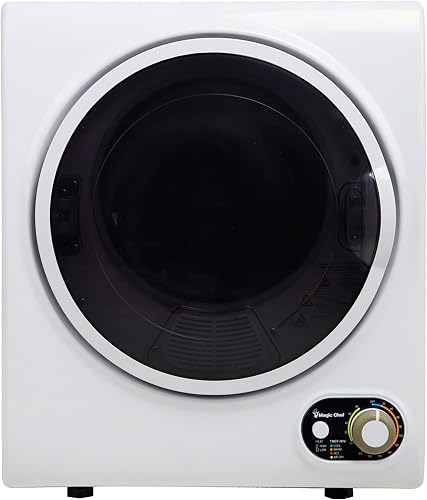
Portable dryers run lower-wattage heating elements inside smaller drums, which directly cuts the cost per load. The Costway VD-23598EP (ASIN B07H16C27H) costs $184.99, handles up to 10 pounds per load, and earns 4.2 stars across 110 reviews. Its stainless steel drum suits apartment use well. A typical cycle draws 1,200 to 1,800 watts, putting the per-load cost at roughly $0.10 to $0.25. The Magic Chef MCSDRY15W (ASIN B01N7RHMKZ), a 1.5 cu ft model priced at $329.71 with 4.3 stars, runs even leaner at around 1,000 watts. For one- or two-person households, either of these cuts the annual drying bill roughly in half compared to a standard electric dryer.
Tips to Reduce Your Dryer Running Cost
The single most effective habit is cleaning the lint filter after every load. A clogged filter reduces airflow, which forces the dryer to run longer and hotter to achieve the same result. Using a moisture-sensor cycle instead of a fixed-time setting also helps; the dryer stops as soon as clothes are dry rather than running an extra cushion of time. Drying full loads is more efficient per item than running half-loads back to back, and spinning clothes at the highest available speed in the washer extracts more water before drying begins. The Westland WDV2200XCD (ASIN B004RCYNVO), priced at $1,414.94 with a 4.2-star rating, pairs an 11-pound capacity with a 1,200 RPM washer spin that leaves clothes drier before they ever enter the drum.
When to Choose a Gas Dryer for Long Term Savings
If your home already has a gas line in the laundry area, a gas dryer can pay back its price premium within a few years of regular use. The Kenmore 8.0 cu ft front-load gas dryer (ASIN B0DFDTPT9G) is one of the top-rated gas options at 4.8 stars. At roughly 0.25 therms per load and a typical gas rate around $1.20 per therm, each cycle costs about $0.30 in gas. Compare that to $0.49 per load for a comparable electric model and the savings accumulate quickly for households that dry every day. The caveat is installation: a gas hookup and proper venting add to setup costs, making gas dryers less practical for renters or homes without existing gas infrastructure.
Frequently asked questions
How much does it cost to run a dryer for one hour?
A 5,000-watt electric dryer running one full hour uses 5 kWh. At $0.13 per kWh, that is $0.65 in electricity. A gas dryer running the same hour costs roughly $0.30 in gas plus a few cents for the motor. Portable dryers at 1,200 to 1,700 watts cost $0.16 to $0.22 per hour.
Is it cheaper to run a gas or electric dryer?
Gas dryers are cheaper to run per load, often by 30 to 50 percent at typical utility rates. However, they cost more to purchase and require a gas line. Electric dryers are simpler to install and carry a lower sticker price, but the operating gap adds up over years of daily use.
How often should I clean the lint filter to save money?
After every single load. A clogged lint filter restricts airflow and forces the heating element to work harder and longer. That can add 20 percent or more to cycle time, which translates directly to higher electricity consumption per load.
Do portable dryers cost less to run than full-size dryers?
Yes. Full-size electric dryers draw 3,000 to 5,000 watts per load, while portable models run at 1,000 to 1,800 watts. The smaller drum finishes lighter loads faster too, so the per-load cost is roughly half that of a standard electric dryer.