How Much Electricity Does a Portable Dryer Use?
Learn how much electricity a portable dryer uses per load, what it costs on your bill, and how to choose an energy-efficient model that fits your space and budget.
A portable dryer typically draws between 1,000 and 1,700 watts, which works out to roughly 12 to 20 cents per load at the U.S. average electricity rate. That is considerably cheaper than a full-size vented dryer, which can pull 3,000 watts or more from the same outlet.
The more precise answer to how much electricity does a portable dryer use is that most models consume around 1.5 kWh per cycle. At 13 cents per kWh, that is about $0.20 per load. Run the dryer once a week for a year and your electricity cost comes to roughly $10. The exact figure depends on the model's wattage, how long each cycle runs, and your local utility rate. Below we explain what drives those numbers, how portable dryers compare to full-size units, and which models balance cleaning capacity with low operating cost.
Products mentioned in this post


Portable Dryer Power Consumption Explained
Portable dryers plug into a standard 120-volt outlet and draw 1,000 to 1,700 watts during operation. A 1,500-watt unit running for one hour consumes 1.5 kWh. A full-size electric dryer on a 240-volt circuit uses 3,000 to 5,000 watts over a similar period. The smaller drum and lower-output heating element explain the gap. Portable dryers are not doing the same job at the same scale, but for households of one or two people running a few loads per week, the capacity is adequate. To estimate your per-load cost, find the wattage on the dryer's spec label, multiply by cycle hours, divide by 1,000 to get kWh, then multiply by your electricity rate.
Key Factors That Affect Electricity Use
Wattage, cycle duration, and how well-loaded the drum is each play a role. Higher-wattage models heat faster, which can mean shorter run times even though the peak draw is higher. Overloading the drum prevents air from circulating properly, forcing longer cycles and more electricity consumption per load. Ventless condenser models run a small fan to cool the condenser coil, adding a modest amount to their draw compared to direct-vent portable units, though the difference is usually minor. Room conditions also matter; a cold or very humid laundry area means the machine works harder to heat the air inside the drum to drying temperature.
Cost Comparison: Portable vs. Full-Size Dryers
At the U.S. average rate, a full-size electric dryer using 3.0 to 5.0 kWh per load costs $0.39 to $0.65 per cycle. A portable dryer using 1.0 to 2.0 kWh costs $0.13 to $0.26. That is roughly a 60 percent reduction in per-load electricity cost. Over 100 loads per year, a portable dryer saves $25 to $40 compared to a standard electric unit. Gas dryers have lower fuel cost per load but require a gas line and venting that most apartment renters do not have access to, making the portable electric option more realistic for that situation.
How to Estimate Your Annual Electricity Cost
The formula is straightforward. Take the dryer's wattage, typically 1,200 to 1,700 watts for portable models. Divide by 1,000 to convert to kilowatts. Multiply by average cycle time in hours, usually 0.75 to 1.5 hours. Multiply by your electricity rate in dollars per kWh. Then multiply by your annual load count. A 1,500-watt dryer running one hour per cycle, 104 loads per year, at $0.13 per kWh: 1.5 kWh times $0.13 times 104 loads equals $20.28 per year. Even at twice-weekly use and the upper end of the rate range, the annual bill stays manageable.
Most Efficient Portable Dryer Models to Consider
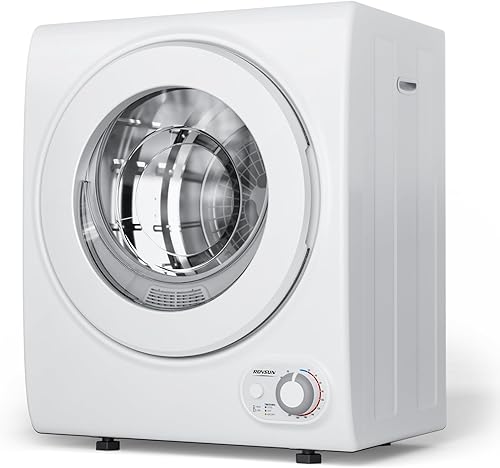
When comparing portable dryers, wattage and drum size are the two most relevant specs. The Panda Pan725sf (ASIN B00EAY540S) offers 1.5 cu ft capacity and earns 4.4 stars from 3,200 reviews, making it one of the most purchased and well-reviewed options in the category. The ROVSUN Classic Knob Control (ASIN B08X6ZJR6C) draws 1,200 watts, handles up to 5.5 pounds per load, and earns 4.4 stars across 1,000 reviews. Its lower wattage translates to lower per-cycle cost. For households needing more capacity, the EUHOMY 3.5 cu ft portable dryer (ASIN B08N4DVVYS) draws around 1,500 watts and earns 4.2 stars from 3,600 reviews. It handles larger loads but costs slightly more to run per cycle than the ROVSUN.
Tips to Reduce Your Portable Dryer Electricity Use
Spin clothes at the highest available speed in the washer before loading the dryer. Clothes that enter the dryer with less residual water need fewer minutes to fully dry. Load the drum to its rated capacity but not beyond; overcrowding traps moisture and extends cycle time. Clean the lint filter after every load without exception; a clogged filter restricts airflow and makes the heating element work harder than necessary. Dry similar fabrics together so the whole load reaches dryness at roughly the same time. Running back-to-back loads while the drum is still warm from the previous cycle is more efficient than letting it cool and reheating from ambient temperature.
Is a Portable Dryer Worth the Electricity Cost?
For a small household in an apartment without dryer hookups, the economics are straightforward. At $15 to $25 per year in electricity at average rates, a portable dryer costs far less to operate than a laundromat dryer, which typically charges $1.50 to $3.00 per load. A portable unit priced between $70 and $350 at purchase pays back the difference in avoided laundromat trips within one to two years. The machines do not replace a full-size dryer for heavy loads or large families, but for the use case they are designed for, the electricity cost is genuinely low enough to not be a meaningful financial concern.
Frequently asked questions
How many watts does a portable dryer use?
Most portable dryers draw between 1,000 and 1,700 watts. The ROVSUN Classic Knob Control is rated at 1,200 watts. The EUHOMY 3.5 cu ft model draws around 1,500 watts. The exact wattage is printed on the product label; that number is what matters for calculating your electricity cost.
Is it expensive to run a portable dryer every day?
No. Running a portable dryer daily for 30 loads per month, at 1.5 kWh per load and $0.13 per kWh, comes to about $5.85 per month. That is less than two laundromat dryer cycles.
Do portable dryers use less electricity than full-size dryers?
Yes, substantially. Full-size electric dryers draw 3,000 to 5,000 watts; portable models draw 1,000 to 1,700 watts. The smaller drum and lower-output element reduce per-load consumption by roughly 60 percent.
Can I use a portable dryer in an apartment without high electric bills?
Yes. Portable dryers are designed for exactly that situation. Their low wattage and short cycle times keep electricity costs low, typically under $25 per year even with regular use. They plug into a standard 120-volt outlet with no special wiring required.