Why Is My Dryer Taking So Long to Dry?
If your dryer runs for hours and still leaves clothes damp, the problem is almost always airflow, load size, or a heat component issue. Here is how to work through each one.
A dryer that takes far longer than normal to dry a load is telling you something specific. It is not just slow: it is working against a restriction, running without adequate heat, or handling more than it can process in a reasonable time.
The most common cause is a lint filter or exhaust vent that has not been cleaned thoroughly enough or often enough. The second most common is a drum so full that clothes cannot tumble. Both are quick fixes. The less common but more serious causes involve a failing heating element, a blocked exhaust path, or a thermostat that cuts the heat cycle too early. This guide covers all of them, starting with the simplest checks.
Products mentioned in this post

Clogged Lint Filter or Vent
A dryer moves air through a hot drum and out through a vent. When the lint filter is partially blocked, less air flows through the drum per minute, which means moisture stays in the load longer. When the vent hose or exterior vent cap is blocked, the same thing happens on a larger scale. The dryer essentially recirculates increasingly humid air rather than expelling it. A lint filter should be cleaned after every load; that is not a recommendation, it is a performance requirement. The vent hose should be inspected at least once a year, more often if the dryer is used daily. Disconnect the hose from the dryer and the wall, then run a vent brush or a vacuum with a long attachment through the full length of the duct. Also check the exterior cap. Many get jammed open with lint or birds build nests in them between uses, both of which cut airflow to almost nothing.
Overloaded Drum
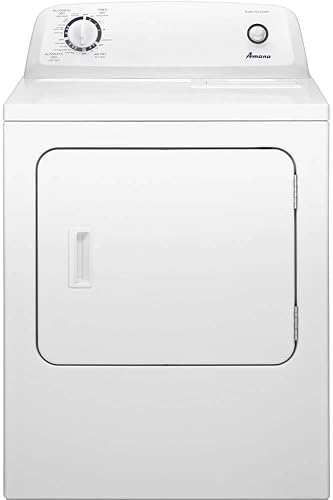
Clothes dry by tumbling through moving hot air. Each item needs space around it for air to reach all surfaces. When a drum is packed full, the pile in the center never tumbles; it stays damp while the outer layer dries. A practical guide is to fill the drum no more than halfway, not three-quarters, not to the brim. For a compact dryer like the Magic Chef MCSDRY1S (2.6 cu ft), that means a small load of mixed clothing or a single set of sheets. For a larger unit like the Amana NED4655EW (6.5 cu ft), you can dry more volume per cycle but the half-full principle still applies. Sheets and towels are particularly prone to balling up in the drum and creating a dense wet mass that the air cannot penetrate. Shake them out before loading and check mid-cycle to separate any bunching.
Incorrect Cycle or Heat Setting
A low-heat or air-dry setting runs the drum without activating the heating element. If someone changed the cycle selector last time and did not change it back, you could run an entire timed cycle without any heat at all, leaving clothes just as wet as when they started. Check the setting before every load. For cotton loads, use high heat. For synthetics and delicates, use medium or low. For machines with a moisture sensor dry option, that mode is usually the most reliable because it stops when clothes are actually dry rather than when a timer runs out. The sensor contacts are small metal strips inside the drum; if they are coated with fabric softener residue they read incorrectly and may end the cycle too early. Wipe them clean with a cloth dampened with white vinegar.
Faulty Heating Element or Thermostat
If the dryer runs, tumbles, and moves air but produces no heat or intermittent heat, either the heating element or the thermal fuse has failed. In an electric dryer, the heating coil breaks over time and trips a thermal fuse as a safety response. In a gas dryer, the igniter or gas valve solenoid can fail in a similar way. A dryer running without heat will still finish a timed cycle and the clothes will feel slightly warmer from the tumbling friction, but they will not be dry. Diagnosis requires a multimeter or a technician. The cost of a heating element plus labor on an older machine often approaches a meaningful fraction of a new dryer's price. For machines under four or five years old, repair is usually worth it. For older units, the Westland WDV2200XCD is a well-regarded compact replacement option worth comparing against service estimates.
Improper Ventilation or Exhaust Routing
The material and configuration of the exhaust duct affects drying performance as much as anything inside the machine. Flexible plastic accordion-style duct hose, which is common in rental installations, traps lint in its ridges and crushes easily into kinks that restrict airflow. Rigid aluminum or steel duct is significantly better: it is smooth inside, does not kink, and does not accumulate lint layers the way corrugated plastic does. Minimize the total duct length and the number of turns. Every 90-degree elbow is roughly equivalent to 5 feet of straight run in terms of resistance. Check that the outdoor vent flap opens fully when the dryer is running; a spring-loaded flap that has lost tension stays nearly closed and restricts exhaust dramatically. For compact dryers like the Costway VD-23598EP that vent through a window, confirm the window kit has no sharp bends at the adapter connection.
Room Temperature and Humidity
A dryer draws in room air, heats it, passes it through the drum, and expels it. In a cold, damp basement or a garage in winter, the incoming air is cold enough to require more energy to reach drying temperature. The machine runs longer to compensate. This is not a malfunction. It is a consequence of where the machine operates. Running a small electric space heater to bring the laundry room temperature up in winter can reduce dry times noticeably, though that has to be weighed against the energy cost. High room humidity, common in basement installations without dehumidification, reduces how much moisture the heated air can absorb per pass through the drum, which extends drying time in a similar way. A standalone dehumidifier running in the laundry space during dryer cycles makes a measurable difference.
When to Replace Your Dryer
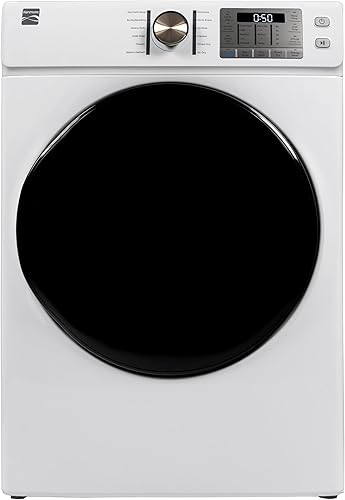
If cleaning the vent, correcting the load size, and verifying the cycle settings do not resolve consistently long dry times, and repair estimates for the heating element or thermostat approach a significant fraction of a new machine's price, replacement makes sense. Look for a replacement whose drum capacity matches your actual household load sizes. The Magic Chef MCSDRY1S (2.6 cu ft) suits one or two people with compact laundry needs. For a larger household, the Kenmore 8.0 cu ft Front Load Gas Dryer has a 4.8-star owner rating and the capacity to handle full family loads efficiently. Compare not just capacity but also cycle options: a machine with a moisture sensor dry mode will manage the end point of each cycle more precisely than a pure timer-based machine, which reduces both under-drying and over-drying.
Frequently asked questions
Why does my dryer take 3 hours to dry clothes?
Three-hour dry times almost always point to restricted airflow. Start with the lint filter, then disconnect and inspect the full exhaust duct for lint buildup and kinks. Also check that the outdoor vent flap opens fully when the machine is running. If airflow is fine, test for a failing heating element.
Can a dryer be too full to dry properly?
Yes. An overfull drum prevents clothes from tumbling through the hot air stream. The clothes pile compresses into a mass that the air cannot penetrate, so everything inside stays wet while the outer layer barely dries. Fill the drum halfway for best results.
How often should I clean my dryer vent?
At minimum once a year for the full duct run. If you do several loads per week, every six months is better. Signs that it is time before the scheduled cleaning include noticeably longer dry times, the laundry room feeling warm, and clothes that are unusually hot when you pull them out.
Is it worth repairing a dryer that takes too long to dry?
For machines under five years old with a single failed component like a heating element or thermal fuse, repair is usually worth it. For machines eight or more years old where repair costs approach half the price of a comparable new dryer, replacement typically makes more financial sense.