How to Choose a Clothes Dryer for Your Home
Recommended picks

Match Dryer Size to Your Household and Space
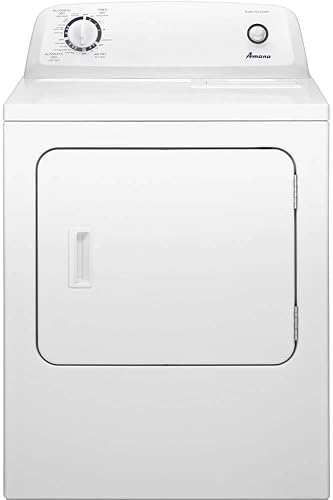
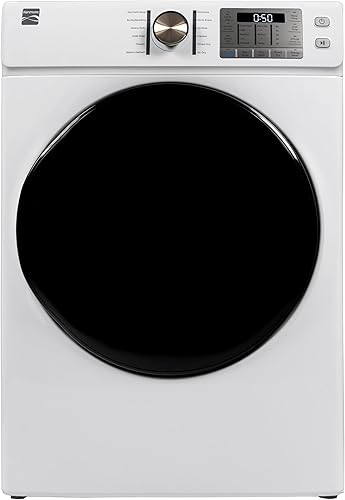
For one person or a couple, a compact dryer in the 1.5 to 3.5 cu ft range handles a realistic weekly laundry volume without requiring a dedicated laundry room. The Magic Chef MCSDRY15W at 1.5 cu ft and the MCSDRY35W at 3.5 cu ft are representative examples. Families of three or more should start at 6.5 cu ft and consider moving up from there; the Amana NED4655EW at 6.5 cu ft and the Kenmore 8.0 cu ft model cover that range. Measure your available width, depth, and height with the door open and a duct run accounted for. Standard full-size dryers run 27 to 29 inches wide. Compact units are typically 17 to 24 inches wide, which is the difference between fitting in a laundry closet and not fitting at all.
Choose Between Vented and Ventless Dryers
Vented dryers push hot, moist air through a duct to the outside. They are the default in homes with a dedicated laundry hookup and dry a load faster than ventless alternatives. Most full-size models, including the Amana NED4655EW, are vented. Ventless dryers condense moisture internally and drain it, with no duct needed. This gives you flexibility on placement: closets, bathrooms, and rooms far from exterior walls all become viable. The Costway VD-23598EP is a portable ventless example. Ventless dryers cost more and cycle longer, but if your home has no duct access, the choice is made for you.
Understand Dryer Capacity and Load Type
Capacity is how much laundry the drum holds per cycle, measured in cubic feet. The practical rule is to match dryer capacity to your washer capacity: if you wash 3.5 cu ft at a time, a 3.5 cu ft dryer handles the full load without splitting. Smaller households manage fine with 1.5 to 3.5 cu ft. Medium households typically want 4 to 6 cu ft. Larger families running heavy loads daily benefit from 7 to 8 cu ft, as seen in the Kenmore 8.0 cu ft model. Load type for dryers is almost always front load, which is standard for both full-size and compact models. The drum material matters too: stainless steel is more durable and gentler on clothes than painted or plastic drums, which can chip or scratch over time.
Evaluate Dryer Cycles and Controls
Basic dryers offer three to four cycles covering cotton, permanent press, and delicates. Advanced models add sensor dry, timed dry, air fluff, wrinkle prevent, and sanitize cycles. The Westland WDV2200XCD includes nine cycles. The Amana NED4655EW covers the essentials without overcomplicating the control panel. Controls come as knobs, buttons, or digital touchscreens. Knob controls are reliable and straightforward, with fewer electronic components to fail. Digital controls offer finer settings but can be harder to repair. Sensor dry is worth looking for specifically: it monitors moisture levels and stops the cycle when clothes are dry, preventing over-drying and saving electricity in the process.
Consider Dimensions and Weight for Installation
Full-size dryers like the Amana NED4655EW measure 28.2 x 29 x 44 inches and weigh 125 pounds. They need a dedicated laundry space and two people to move. Compact dryers like the CTT CTTP10-White at 26.5 x 20 x 22.5 inches and 67 pounds can fit in a laundry closet or under a counter. Portable models such as the Costway VD-23598EP at 19.5 x 24 x 16.5 inches and 37 pounds can be stored between uses. If you plan to stack the dryer on a washer, confirm the combined weight is within floor limits and that the stacking kit is compatible with both machines. Stacking kits are usually brand-specific and sometimes sold separately.
Compare Price and Value Across Brands
Budget portable dryers start around $185, with the Costway VD-23598EP at $184.99 representing that entry point. Compact models occupy the $330 to $550 range; the Magic Chef MCSDRY15W is $329.71 and the MCSDRY35W lists at $541.81. Full-size dryers begin around $590 with the Amana NED4655EW and climb to $1,400 for the Westland WDV2200XCD. Premium models with large drums and advanced cycles, like the Kenmore 8.0 cu ft at $1,149 to $1,199, sit in the middle of that upper range. A simpler dryer with fewer electronic components often means lower repair costs and better long-term reliability. Buy the features you will actually use rather than the longest spec list.
Check Customer Ratings and Reliability
Rating averages are more meaningful when paired with a substantial review count. The Magic Chef MCSDRY1S holds a 4.2-star average across roughly 1,200 ratings, which provides a reasonable data set. The Splendide DV6400X earns 4.5 stars but from only 28 ratings, which limits how much confidence to place in that average. The Amana NED4655EW sits at 4.4 stars across 87 ratings. Look for patterns in lower ratings: recurring mentions of the same issue, such as noise, inconsistent heating, or control failures, are more meaningful signals than isolated complaints. Also check warranty length. Most dryers include a one-year limited warranty. Some brands extend coverage on the drum or motor, which matters more for higher-priced units.
Decide on Smart Features and Special Functions
Wi-Fi-connected smart dryers let you monitor cycle status and receive alerts from a phone app. Most models in the accessible price range, including the Westland WDV2200XCD and the CTT CTTP10-White, are not smart-home compatible. Smart features cost more and can become obsolete when app support ends or the home assistant ecosystem changes. Special functions like delay start, steam, and wrinkle prevent add practical value for some households. Steam cycles reduce wrinkles and odors without rewashing. Delay start lets you schedule a cycle to finish when you arrive home. If these matter to you, factor them in. If not, a dryer without them will be simpler and often more reliable.
Weigh Portable vs. Full-Size for Apartments
In apartments where both space and hookups are limited, portable dryers solve a real problem. They plug into a standard outlet, often require no permanent venting, and store when not in use. The Costway VD-23598EP at $184.99 and the Magic Chef MCSDRY15W at $329.71 represent different points on the capacity and price curve for this category. A small load typically dries in 30 to 60 minutes. For a larger apartment with a dedicated laundry closet and a window for venting, a compact or small full-size unit is worth considering for the time savings on larger loads. Always check whether your building allows vented dryers before buying one that requires a window hose or duct.
Match Dryer to Your Washer for Stacking
Stacking a dryer on a washer saves floor space but requires both machines to be compatible. Front-load dryers stack on front-load washers using a manufacturer-approved stacking kit. The Kenmore 8.0 cu ft dryer can be stacked with a matching Kenmore front-load washer. Compact dryers like the Magic Chef MCSDRY35W at 21.5 inches wide can also be stacked with a compatible compact washer. Never stack machines without a proper kit: the kit holds the dryer in position and prevents dangerous shifting during high-speed spin cycles. Stacking reaches heights of 60 to 70 inches for full-size units, which makes the upper machine controls harder to reach for shorter users.
Common mistakes to avoid
- Ordering a dryer before measuring the space, only to find the unit does not fit through the doorway or into the laundry area.
- Choosing a vented dryer for a home with no exterior vent, then facing a costly ductwork installation after the fact.
- Underestimating capacity needs, which forces multiple dryer cycles for a single washer load and wastes time.
- Overlooking drum material and choosing a painted or plastic drum that scratches fabric or chips after a year of use.
- Buying a dryer without checking lint filter accessibility, only to find it requires disassembly or awkward reach to clean properly.
- Ignoring door swing direction, which in a tight laundry space can make loading and unloading genuinely difficult.
Frequently asked questions
What size dryer do I need for a family of four?
A family of four doing regular laundry needs at least 6.5 cu ft of drum capacity to handle a typical full load in one cycle. The Amana NED4655EW at 6.5 cu ft is a reasonable starting point. The Kenmore 8.0 cu ft model handles larger loads without leaving anything behind.
Can I use a portable dryer in an apartment without vents?
Yes, if you choose a ventless model. Condenser-type portable dryers, like the Costway VD-23598EP and the Magic Chef MCSDRY15W, capture moisture in a tank and drain it away without requiring a duct. They need only a standard 120V outlet and a water drain connection.
What is the difference between a vented and ventless dryer?
Vented dryers push moist air out through a duct to the outside, drying faster and at lower purchase cost. Ventless dryers condense moisture internally and collect it in a tank or drain. They cost more and dry more slowly but can be placed anywhere with an outlet.
How much does a good full-size dryer cost?
A reliable full-size vented dryer like the Amana NED4655EW runs around $590. Step up to larger capacity and more cycles, such as the Kenmore 8.0 cu ft, and prices move into the $1,100 to $1,200 range. Premium features like steam drying or smart connectivity add further cost.
Is it better to stack a dryer or buy a combo unit?
Stacking keeps wash and dry as separate, independently replaceable functions. Combo units combine both in one footprint but sacrifice capacity and cycle speed. For larger households that need throughput, stacking is more practical. For small apartments where convenience and space savings matter most, a combo unit is worth the tradeoffs.