What Are the Best Portable Washers for Apartments?
Recommended picks

Why Choose a Portable Washer for Your Apartment?
Apartments without laundry hookups leave residents choosing between a shared laundromat and a portable washer. A portable unit connects to any threaded kitchen or bathroom faucet, runs on a standard outlet, and can be rolled into a closet after use. The main trade-off is capacity: most portable washers hold 0.9 to 2.0 cubic feet per load, so you will wash smaller batches more often than you would with a full-size machine. Two styles are available. Semi-automatic twin-tub models ask you to transfer clothes between the wash and spin compartments; fully automatic single-tub models handle every step in one drum. For apartment living where time and convenience matter, fully automatic machines are almost always the better fit.
Key Features to Look for in a Portable Washer
Capacity is the starting point. Singles should look for at least 0.9 cubic feet; couples will appreciate 1.5 to 2.0 cubic feet. Drum material is next: stainless steel drums resist corrosion, last longer, and are gentler on fabrics than polypropylene equivalents. Multiple cycles add flexibility, particularly a quick-wash setting for light loads and a delicate cycle for dress shirts or blouses. Spin speed matters more than buyers often realize: a 1300 RPM spin leaves clothes significantly drier than a 760 RPM spin, reducing the time your clothes spend hanging or in a portable dryer afterward. Noise rating should be below 65 dB for an apartment situation where neighbors are close. Finally, look for a compact footprint and included hoses and adapters, so you are ready to run the first cycle without a separate hardware-store trip.
Top Pick: Comfee CLV09N1AMG (Best Balance of Size and Price)
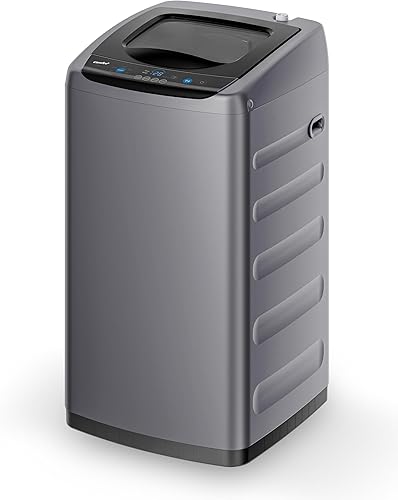
The Comfee CLV09N1AMG is a well-reviewed choice for apartment dwellers who want a fully automatic experience without a large footprint. It holds 0.9 cubic feet, which suits one person or a couple washing smaller loads. It offers five cycles including a quick-wash option, and the stainless steel drum is gentle on everyday clothing. Spin speed is 840 RPM, which will leave some moisture in heavier fabrics but performs adequately for shirts and casual wear. The dimensions are 17.7 by 18.1 by 31.5 inches, so it fits under many counters. With 4.4 stars across more than 8,400 reviews and a price of $259, it represents solid value in the mid-range. The noise level of 62 dB is moderate and acceptable for most apartment settings.
Budget Friendly Option: Costway GT-23104-CYWH
If keeping the purchase price below $100 is the priority, the Costway GT-23104-CYWH is worth considering. At $85.99, it is a semi-automatic countertop model with a 5.5-pound capacity, suited to small loads of delicates, undergarments, or a few shirts. The unit weighs 12.1 pounds and measures 13.5 by 14 inches, making it easy to store on a shelf or in a cabinet when not in use. It has a single wash cycle with knob controls, so it is uncomplicated to operate. The noise rating of 45 dB is genuinely quiet, one of the lowest figures among portable washers. The trade-off is the semi-automatic design: you move wet clothes to the spin basket yourself after the wash phase. This model is best for a single person who washes small loads frequently and has a firm $100 budget.
Largest Load Capacity: Brand BPWM20W
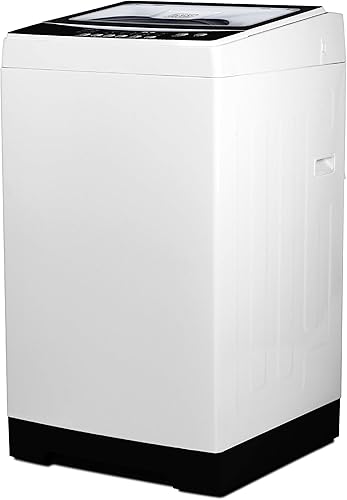
The Brand BPWM20W offers 2.0 cubic feet of capacity, making it one of the most spacious portable washers available. A couple or small family can wash a larger load of clothing, light towels, and bedding without splitting the batch. It is a semi-automatic design with push-button controls, six cycle options, and a stainless steel drum. Spin speed is 760 RPM, which is modest, though the larger drum compensates somewhat by holding heavier items. At 22.2 by 21.6 by 37.4 inches, it is a sizable freestanding unit that requires a dedicated floor spot rather than counter space. The 4.4-star rating across 9,100 reviews and a price of $386.09 reflect strong demand for the extra capacity. At 72 dB it is among the louder options, so placement away from sleeping areas is wise.
Best Fully Automatic Under $200: Nictemaw Nic-5573-2
The Nictemaw Nic-5573-2 offers a useful combination of fully automatic operation and 2.4 cubic feet of capacity at $199.99, which is a competitive price for that combination. It has ten cycles covering delicate through heavy-duty loads, a stainless steel drum, and a 1300 RPM spin speed that extracts water efficiently. The freestanding dimensions of 18.9 by 18.9 by 32.7 inches fit into most laundry closets or corners. With 431 reviews at a 4.2-star average, the sample is smaller than the Comfee or Giantex, but the pattern is positive. This model makes sense for apartment residents who want a fully automatic machine with meaningful capacity but do not want to spend more than $200.
How to Connect a Portable Washer to Your Apartment Sink
Most portable washers connect to a kitchen faucet through a plastic or brass adapter that replaces the faucet's aerator tip. Remove the aerator by hand or with a cloth-wrapped wrench, screw on the adapter, and attach the washer's inlet hose to the adapter's quick-connect fitting. Turn the faucet on and the machine fills automatically. For drainage, the included hose drapes over the sink edge; a U-shaped clip or notch in the drain hose keeps it from sliding into the basin. If your kitchen faucet has a pull-out spray head, you may need a diverter valve, available for a few dollars at a hardware store. Models like the Comfee CLV09N1AMG include everything needed for first-time setup in the box.
Space Saving Tips for Your Portable Washer
The smallest countertop models, like the Costway GT-23104-CYWH at 13.5 by 14 inches, sit on a table or counter while in use and stow under a bed or in a cabinet afterward. Freestanding units with casters can be rolled to the sink for a cycle and then into a closet corner. Storing the hoses and the faucet adapter inside the washer drum keeps all the pieces together and avoids a drawer full of loose fittings. If the machine sits on a hardwood or tile floor during use, a non-slip rubber mat prevents it from creeping during the spin cycle. Leave at least a few inches of clearance above the lid so it can open fully without hitting a shelf or cabinet bottom.
Maintenance and Longevity of Portable Washers
A few simple habits extend a portable washer's useful life considerably. Clean the lint filter every few loads; it is usually found in the drum or along the drain hose. Wipe the drum and any door or lid seals with a damp cloth after each week of use to prevent mildew buildup. Leave the lid open between cycles so moisture can evaporate. Every couple of months, run an empty cycle with a washing machine cleaner or a diluted white vinegar solution to remove mineral deposits. Check the hose connections periodically for soft spots or small cracks. With reasonable care, a stainless steel drum portable washer can provide several years of reliable service.
Common mistakes to avoid
- Buying a washer with too small a capacity for two people and ending up running it twice a day just to stay current with laundry.
- Ignoring the noise rating and installing a 70-plus dB machine in a studio apartment where it disturbs sleep and neighbors.
- Ordering without confirming the faucet type and then finding the included adapter does not fit a pull-down spray head.
- Choosing a semi-automatic twin-tub model expecting set-it-and-forget-it convenience, then being frustrated by the manual transfer step.
- Forgetting that a portable washer does not dry clothes, and having no plan for where wet laundry will go after the spin cycle.
Frequently asked questions
Can I use a portable washer in any apartment?
In most cases, yes. You need a sink with a threaded faucet, a standard grounded outlet nearby, and a level surface for the machine. Most portable washers include a universal faucet adapter. Apartments with only pull-down spray faucets may need an inexpensive diverter valve.
How much water does a portable washer use?
A typical load in a portable washer uses 5 to 10 gallons, depending on cycle selection and load size. That is roughly a third of what a traditional full-size machine uses per cycle, which keeps water costs low for small-load laundry.
Do I need a portable dryer too?
Not necessarily. Air drying on a collapsible rack works fine for most fabrics, especially if you run a high spin speed that removes most of the moisture. A portable dryer speeds things up considerably but adds cost and needs its own floor space and outlet.
How long does a portable washer last?
With regular maintenance, including cleaning the lint filter and running occasional cleaning cycles, a portable washer with a stainless steel drum can last several years. Models with plastic drums tend to show wear sooner under frequent use.
Are portable washers energy efficient?
Yes. Because they wash smaller loads with less water, portable washers use less energy per cycle than most full-size machines. Many also offer cold-water cycles, which avoid the energy cost of heating water entirely.