How to Choose a Portable Washing Machine: A Complete Guide
Recommended picks

Start with Capacity: How Much Laundry Do You Do?
Capacity is the single most consequential spec because it sets an upper limit on every load you will ever run. For one person or a dorm situation, a compact model in the 0.84 to 1.0 cubic foot range handles light loads of shirts, underwear, and delicates without much fuss. The Avanti CTW84X0W-IS sits at 0.84 cubic feet, and the Farberware FCW10BSCWHA reaches 1.0 cubic foot. Step up to 1.3 to 2.0 cubic feet for two people. The Giantex EP23113 at 1.34 cubic feet handles moderate loads, while the Brand BPWM20W at 2.0 cubic feet fits jeans and small towels in the same cycle. Above 2.0 cubic feet, you are approaching full-size machine dimensions. The Nictemaw NI5573_8_GR at 2.8 cubic feet gets there. Pay attention to the pound rating as a cross-check: a 20-pound capacity translates roughly to 2.0 cubic feet. Pick the smallest capacity that covers your weekly laundry without running the machine more than twice a day.
Decide Between Semi-Automatic and Fully Automatic
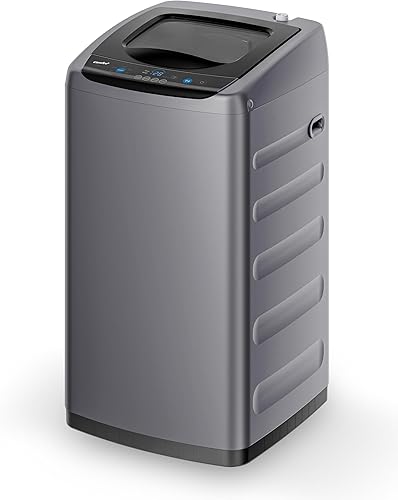
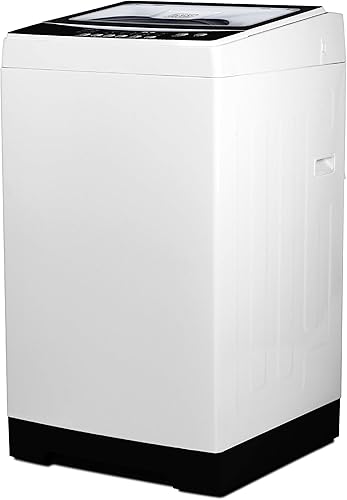
The operation type determines how much time you spend babysitting each cycle. Semi-automatic machines, including twin-tub designs like the Giantex EP21684, require you to move wet clothes from the wash basket to a separate spin tub. That extra step costs a few minutes per load but lets you control soak time and water reuse. Fully automatic single-tub washers like the Comfee CLV09N1AMG or Hamilton Beach HBPW3O2AMZ handle filling, washing, rinsing, and spinning in one drum. You load the clothes, pick a cycle, and walk away. Fully automatic machines cost more, generally $200 to $450 versus $100 to $200 for semi-automatic equivalents, but they save real effort. If mobility is a concern or if your schedule does not allow you to stand by the machine, fully automatic is the practical call.
Measure Your Space: Dimensions and Hookup Access
Portable washers divide into countertop and freestanding footprints. Countertop models like the Costway GT-23104-CYWH at 13.5 by 14 by 20 inches sit on a table or counter, weigh around 12 pounds, and store under a desk between uses. Freestanding units like the Giantex EP23113 at 19.7 by 19.8 by 33.6 inches stay on the floor and require a permanent spot or rolling storage. When you measure, account for the hoses that exit from the back: leave at least four to six inches of clearance. Most portable washers connect to a standard kitchen faucet through a universal adapter included in the box, so the sink must be within reach of the inlet hose. Check that your sink basin is deep enough to accept the drain hose without backflow when the pump runs.
Compare Cycle Options and Spin Speed
A basic semi-automatic machine might offer a single wash timer and a separate spin timer, which is enough for simple loads. Fully automatic models range from five cycles on the Comfee CLV09N1AMG to twelve on the Hamilton Beach HBPW3O2AMZ, adding options like delicate, heavy-duty, quick wash, and rinse-only. More cycles matter if you regularly wash a mix of fabric types. Spin speed is equally important: higher RPM extracts more water and cuts drying time. Many Giantex and Nictemaw models reach 1300 RPM, while some budget fully automatic units spin at only 760 to 840 RPM. A drum listed as stainless steel is gentler on fabrics and resists corrosion better than polypropylene. Noise ratings span a wide range, from 45 dB on the quieter Costway countertop unit to 78 dB on louder freestanding models, so check that figure carefully if you live in a thin-walled building.
Consider Your Budget and Long-Term Value
Manual and semi-automatic washers with plastic drums start below $100. The Pyle PUCWM11 is one example at $89.99. These suit occasional users who wash small loads and are comfortable with the manual steps. Mid-range machines from $150 to $300, such as the Giantex EP21684 at $149.99 or the Comfee CLV09N1AMG at $259, add stainless steel drums, greater capacity, and fully automatic cycles. Premium portables from $400 to $450, like the Avanti STW16D0W or the Wattsmart AP-WM002, approach the price of entry-level full-size machines but remain faucet-connected and portable. When comparing prices, think about frequency of use: someone running two or three cycles per day needs a more durable machine than someone who washes once a week. Models with high review counts and strong ratings, like the Giantex EP23113 with over 4,200 reviews at 4.4 stars, provide better evidence of real-world reliability than a cheaper machine with 50 reviews.
Read Ratings and Review Patterns
Star ratings and review volume together tell a more useful story than either figure alone. A 4.4-star average across 8,400 reviews, as the Comfee CLV09N1AMG shows, suggests consistent satisfaction across a wide range of buyers and usage conditions. A 4.2-star average across 15,200 reviews, like the Giantex EP21684, indicates that the occasional complaint is outweighed by a large majority of satisfied owners. Pay attention to the volume of recent purchases too: a machine that sold over 100 units last month is still in active demand, which usually means the manufacturer is supporting it and parts are available. Avoid machines with ratings below 3.5 stars or very few reviews unless you have a specific reason to trust the product.
Match the Machine to Your Household Size
One person living alone or in a dorm will get good results from a compact unit at 0.9 to 1.34 cubic feet. The Comfee CLV09N1AMG is a widely-reviewed option in that range. Two people sharing an apartment typically need 1.5 to 2.0 cubic feet to avoid running the machine every day. The Brand BPWM20W at 2.0 cubic feet and a 4.4-star rating handles that load comfortably. Families of three or more who want to rely on a portable washer as a primary machine should look at the Nictemaw NI5573_8_GR at 2.8 cubic feet or the Rovsun portable at 2.3 cubic feet. Larger capacities almost always mean larger physical footprints, so confirm the floor space is available before ordering.
Examine the Drum Material and Build Quality
Drum material affects both longevity and how the machine treats your clothes. Stainless steel drums resist chipping and corrosion, and their smooth interior does not snag delicate fabrics. They appear on higher-end models including the Hamilton Beach HBPW3O2AMZ, Krib Bling KB02-GOLD6, and Giantex EP23113. Plastic drums are lighter and cheaper, which keeps costs low, but they can develop hairline cracks after months of heat cycling and may nick thin fabrics at seam edges. Budget models under $150 usually use plastic. If you expect to run the machine four or five times a week for a year or more, the extra cost of a stainless steel drum is a reasonable investment. Physical weight also correlates roughly with build quality: machines over 40 pounds tend to be more stable during high-speed spin cycles, producing less walking and vibration.
Factor in Water and Electrical Requirements
Portable washers plug into a standard 110 to 120 volt outlet and typically draw less than 10 amps, meaning they can share a circuit without tripping the breaker. Do not use an extension cord: plug directly into a wall outlet. Water comes from the sink faucet through an adapter; the drain returns through a hose that hangs into the sink or over the tub edge. Some fully automatic models use built-in pumps that lift water vertically, so a countertop-height drain works fine. Semi-automatic machines let you control how much water you use, which is useful in areas where water is expensive. Models like the Giantex EP21684 include a faucet adapter and drain hose in the box, so you usually need nothing extra at purchase to get started.
Review the Warranty and Return Policy
Most portable washers come with a one-year limited warranty covering parts and labor. Some brands offer longer coverage, but the standard terms are otherwise similar across manufacturers. Amazon's return window for large appliances is typically 30 days, and restocking fees may apply, so it pays to be confident in your choice before ordering. Products with high review counts and strong ratings offer indirect evidence of low defect rates: the Giantex EP21684 at 15,200 reviews and 4.2 stars suggests the failure rate is low enough that positive feedback dominates. For models with fewer reviews, check the brand's customer support reputation before committing. A longer warranty is worth prioritizing when two otherwise comparable models are close in price.
Common mistakes to avoid
- Buying a machine with too small a capacity for your household size and then running it two or three times a day to keep up.
- Skipping the measuring step and discovering the machine does not fit under your counter or through the apartment door.
- Choosing a semi-automatic model expecting push-button convenience, then finding the manual transfer step frustrating.
- Opting for a plastic-drum machine to save $30 to $50, only to have the drum crack within a year of regular use.
- Ignoring the noise rating and ending up with a 78 dB machine that disturbs neighbors in a building with thin walls.
Frequently asked questions
What size portable washing machine do I need for a small apartment?
For one or two people in a small apartment, a machine with 0.9 to 1.5 cubic feet of capacity is usually sufficient. The Comfee CLV09N1AMG at 0.9 cubic feet handles everyday loads for a single person, while the Giantex EP23113 at 1.34 cubic feet gives a couple a bit more room per cycle.
Can I use a portable washing machine without a permanent water connection?
Yes. Portable washers connect to a standard faucet through a supplied adapter and drain through a hose placed over the sink edge. No plumbing work is required. Just confirm your faucet has a threaded aerator and that the drain hose reaches the basin comfortably.
How do portable washers compare to full-size washers in cleaning performance?
For everyday loads of clothing, portable washers with stainless steel drums and multiple cycles perform adequately. They generally have smaller drums and lower spin speeds than full-size machines, so heavily soiled large items or bulky bedding may need pre-treatment or multiple cycles to reach the same result.
What is the difference between a semi-automatic and fully automatic portable washer?
A semi-automatic machine requires you to move clothes from a wash tub to a spin tub and drain the water manually. A fully automatic machine handles fill, wash, rinse, and spin in a single drum with no intervention. Fully automatic models cost more but save meaningful time and effort per load.
How do I prevent a portable washer from vibrating and moving during the spin cycle?
Place the machine on a level, solid surface and avoid overloading it. An unbalanced load causes the most vibration. Heavier freestanding units over 40 pounds are more stable by nature. For lightweight countertop models, a non-slip mat under the machine helps considerably.